 By Editorial Team
For venture capitalists and private equity investors trying to make sense of the healthcare AI space, you’ve got to get the economic models right. An AI tool’s financial return and its ultimate ROI are completely tied to how doctors and hospitals get paid. So let’s break down the two main payment models, capitation and fee-for-service (FFS), because they determine where AI can actually make money. How a provider is paid isn’t just context, it’s the single biggest factor in whether an AI tool will be a financial success or a flop.
The Big Split: How Capitation vs. FFS Changes AI’s ROI
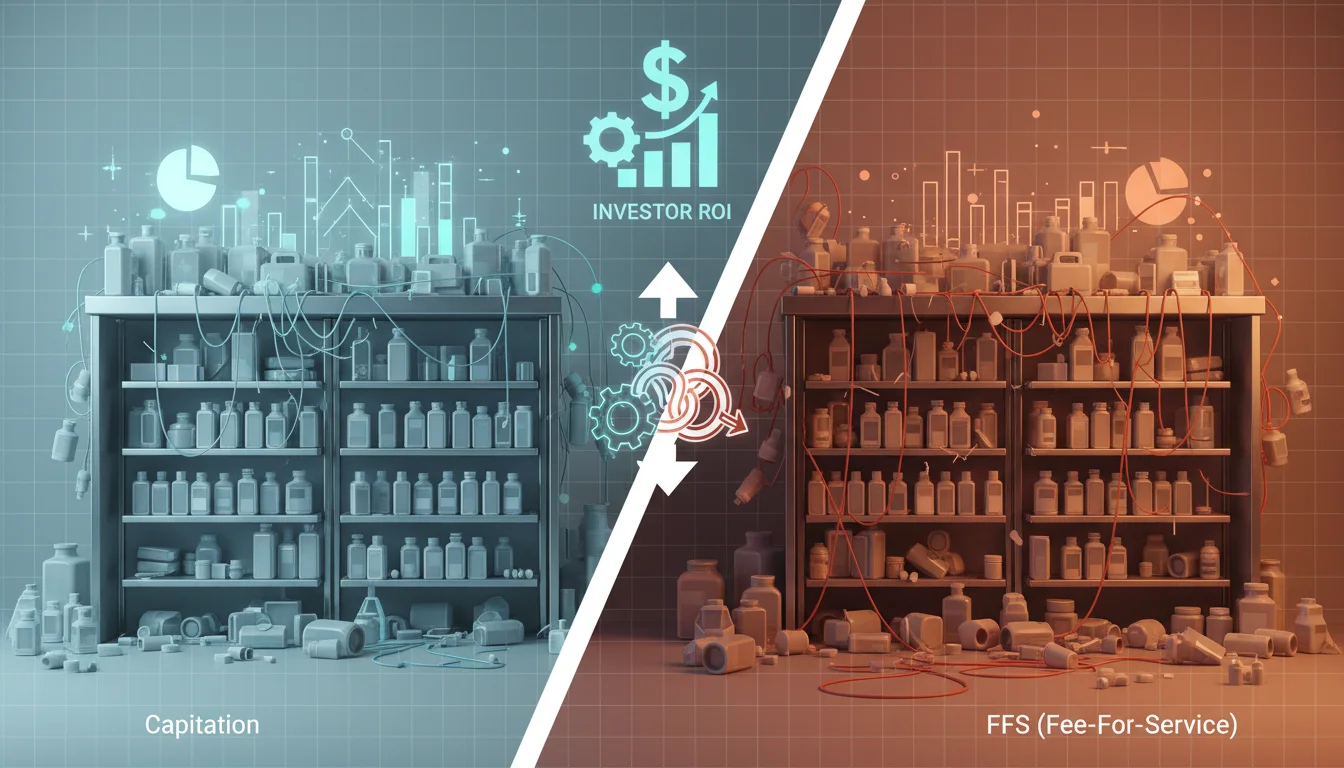
The entire ROI calculation for healthcare AI hinges on one thing: how the doctor gets paid. In a fee-for-service world, providers are paid for every single thing they do which naturally encourages doing more things. AI tools that help a radiologist read scans faster or automate billing can create some operational savings, but their effect on top-line revenue is pretty indirect, mostly just freeing up time to do more procedures. But under capitated models, everything is flipped on its head. Providers get a flat fee per patient for a set period, no matter what services they deliver. Suddenly, the incentive is to manage the health of a whole population, prevent expensive problems before they start, and keep people out of the hospital. Is it any surprise that this is where AI shines? AI that predicts who’s at risk for a crisis, gets them in for early treatment, or personalizes a care plan goes straight to the provider’s bottom line by lowering total spending. The difference is night and day. Under FFS, an AI that lets a surgeon do more operations is valuable. Under capitation, an AI that helps a patient avoid an operation is a direct profit driver. This means the highest-ROI use cases for AI are completely different depending on the payment model, and investors have to check if a startup’s AI actually helps their target customers make more money under their specific payment system.
Oak Street Health: AI in a Full-Risk Capitated World
Look at Oak Street Health. They’re a perfect case study of making AI work in a full-risk capitation model. They work mostly with Medicare Advantage plans, getting a fixed payment for each senior they enroll. Their entire business is built on aggressive, preventive primary care to keep their very sick patients out of the ER and hospital beds which is where the real costs are. This is exactly the environment where AI delivers a huge ROI. Oak Street uses its own tech and AI analytics to spot patients who are at high risk of being hospitalized, manage their chronic diseases better, and build personalized care plans. For example, their AI can scan electronic health records (EHRs) for signs that a patient’s health is declining, triggering a call from a nurse or a quick appointment that heads off an expensive emergency room visit. In a capitated system, every single one of those avoided hospitalizations translates directly into profit. Oak Street Health investor relations reports on care model effectiveness The numbers back this up. By hammering on care coordination, preventive screenings, and intensive management of chronic illness, all guided by AI, they bring down the total cost of care for the patients they’re responsible for. That lets them keep a much bigger slice of their fixed payments, showing a direct and very clear ROI for their AI. The success of a model like this is measured by its ability to get better health outcomes for a lower per-member-per-month (PMPM) cost, which is the whole game under capitation.
Aledade and the Shared Savings Model (MSSP)
Aledade shows a different path, operating in a shared savings model, primarily through the Medicare Shared Savings Program (MSSP). It’s a bit different than full-risk capitation. With MSSP, groups of providers called Accountable Care Organizations (ACOs), like the ones Aledade partners with, agree to be responsible for the cost and quality of care for their patients. If they can keep healthcare spending below a benchmark set by the government while also hitting quality goals, they get to keep a piece of the savings they generated for Medicare. The Center for Medicare and Medicaid Innovation (CMMI) is the agency that sets the rules and runs this whole program. Aledade’s strategy is to give independent primary care doctors the AI and data tools they need to actually win at this game. Their software chews through claims data and EHRs to find gaps in care (like a missed cancer screening) or predict which patients might be heading for a health crisis, allowing doctors to step in proactively. While it isn’t the full financial risk of capitation, these shared savings models push incentives in the same direction: cut down on waste and improve patient health. Aledade’s pitch to doctors is simple: we provide the AI-powered infrastructure that helps you earn those shared savings bonuses. The ROI, then, for both Aledade and its partner clinics, is directly tied to their success in lowering the total cost of care for their Medicare patients. Public data from the MSSP shows this works. High-performing ACOs, often the ones with strong data analytics, can generate big savings. For example, in 2023, ACOs in the program earned $3.1 billion in shared savings payments and saved the system over $2.1 billion net. In 2024, the program hit a record $2.48 billion in savings for taxpayers, with $4.1 billion paid out to doctors and 75% of ACOs earning a performance payment. CMS MSSP annual performance reports This shows that even without taking on 100% of the risk, AI can generate real financial returns by making care more efficient inside a value-based system.
A Framework for Vetting AI Investments Against Payment Models
So, for an investor, what’s the playbook? Here’s a simple framework for vetting a health AI company based on these payment realities:
Identify the Primary Revenue Stream of the Target’s Customers
First, who are their customers? This is the most important question you can ask. Are they selling to big hospital systems that run mostly on fee-for-service, or are they selling to value-based care groups, capitated plans, or ACOs in shared savings programs? The distinction is everything. An AI tool that’s brilliant at reducing inpatient hospital days is a goldmine for a capitated provider like Oak Street, but it’s a potential revenue-killer for a traditional FFS hospital that gets paid per bed-day.
Evaluate AI’s Direct Impact on Financial Levers
Next, does the AI actually move the needle on the key financial levers? For a capitated plan, AI that cuts down on unnecessary tests or helps manage chronic conditions is a direct line to profit. For a shared savings ACO, it’s all about hitting quality metrics and cutting avoidable costs to earn that bonus at the end of the year. For an FFS provider, the ROI is usually softer and harder to measure, maybe some operational efficiency, reduced paperwork for staff, or better diagnostic accuracy that helps justify billing. As an investor, you have to trace a clear line from the AI’s core function to the customer’s P&L.
Consider Integration Costs and Scalability
Finally, don’t forget about integration costs and workflow friction. A brilliant AI tool that’s a nightmare to install or requires doctors to change their entire workflow will never get adopted. The costs to get these tools running, from data access to staff training and maintenance, have to be baked into any ROI math. The price tags can be all over the place, from around $10,000-$50,000 for a small-scale chatbot pilot to $50,000-$300,000 for a diagnostic AI, and well over $300,000 for an enterprise-wide system that plugs deep into the EHR. A solution with high integration friction will probably fail to deliver a positive ROI, no matter its potential. And you have to think about scalability. Can the tool work across different payment models, or is it a one-trick pony? That will determine its total addressable market.
Methodology and Source Note
These points aren’t just theory. They come from looking at how real value-based care groups operate and modeling their finances. The insights on capitation and shared savings are built from public data from the Centers for Medicare & Medicaid Services (CMS), especially their MSSP performance datasets, and from reading peer-reviewed health policy literature. Companies like Oak Street Health and Aledade, and agencies like CMMI, provide the real-world examples of how these financial models work in practice. For the deepest dive, investors should always go to the primary sources, like the CMS reports and company financial filings. Peer-reviewed health economics journals on value-based care Knowing the difference between payment models is what determines whether an AI company makes money or just burns through venture capital. It dictates the economic engine behind AI adoption in medicine. For VCs and PE investors looking at value-based care, understanding these dynamics is how you spot the AI companies that are positioned for outsized returns.
Frequently Asked Questions
How does the reimbursement model impact the ROI of AI in healthcare?
The reimbursement model profoundly shapes the ROI of AI tools. In fee-for-service, AI’s value is often indirect, focusing on efficiency. In capitated models, AI directly drives profit by reducing overall healthcare expenditures and preventing costly interventions, leading to higher ROI.
Which payment model offers the highest ROI for AI applications in healthcare?
Capitated models generally offer the highest ROI for AI applications. In these models, AI tools that predict risk, facilitate early intervention, or personalize care pathways directly contribute to retaining more of the fixed payment by reducing overall healthcare expenditures.
Can you provide an example of a successful AI integration within a capitated model?
Oak Street Health exemplifies successful AI integration within a full-risk capitation model. They use AI-driven analytics to identify high-risk patients and personalize care plans, directly increasing profitability by avoiding expensive inpatient settings and retaining a larger portion of their capitated payments.
How does AI create value in a shared savings model like MSSP?
In shared savings models, AI creates value by empowering providers to reduce healthcare spending below benchmarks while meeting quality targets. AI tools analyze data to identify care gaps, predict patient risk, and guide interventions, leading to shared savings with Medicare and a direct ROI for participating practices.


