 By Editorial Team
Everyone talks up AI in healthcare with promises of massive efficiency gains and super-accurate diagnostics. But here’s the reality: the financial ROI hangs entirely on one thing that the initial spreadsheets always seem to miss, getting clinicians to actually use the tool. You can have the most sophisticated AI on the planet, but if it sits there unused because doctors are skeptical, drowning in alerts, or can’t fit it into their chaotic workflow, its benefits are purely imaginary. This is a quick rundown of clinician feelings about AI decision support, using stroke care as a specific example to show why a good user experience isn’t a “nice-to-have” but the absolute bedrock of any financial return.
The Adoption Imperative: Why Clinician Trust Drives AI ROI
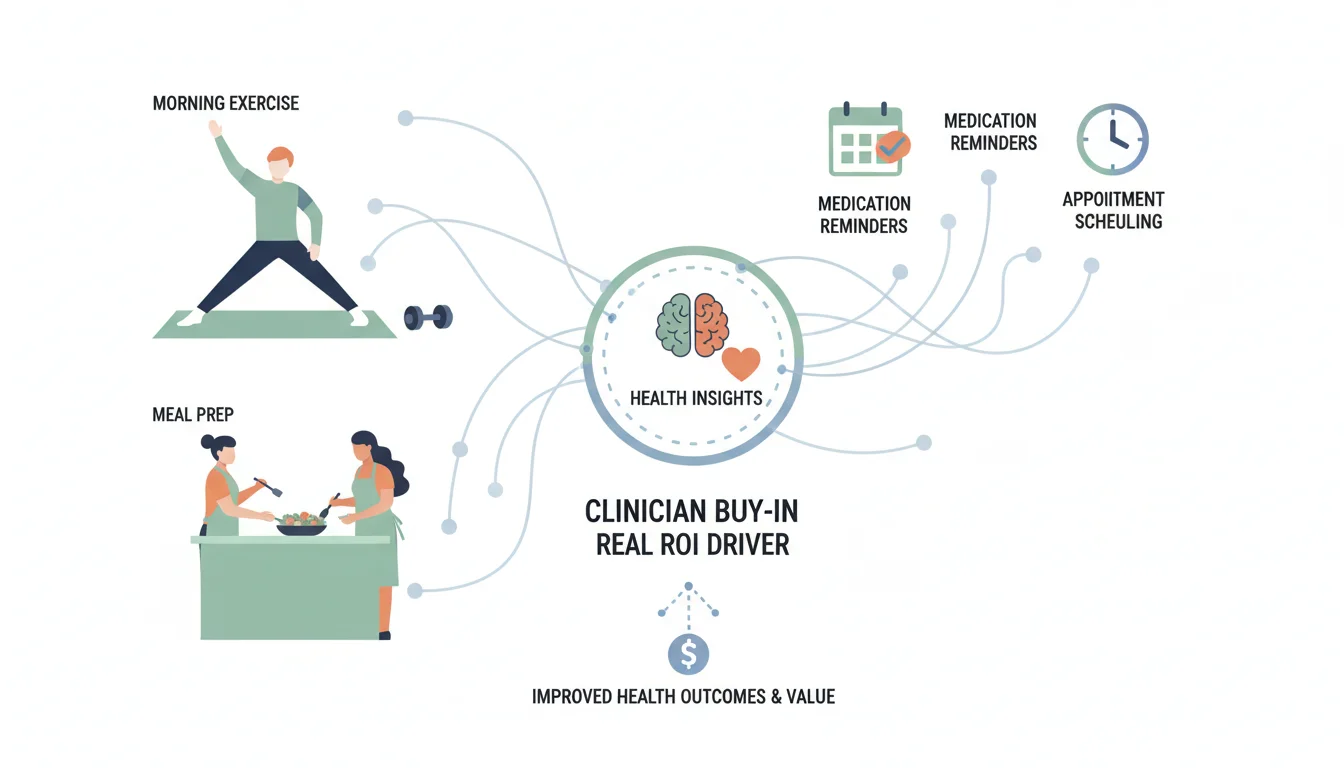
Any digital health VC or hospital leader who’s been around the block knows that clinical AI isn’t a ‘build it and they will come’ situation. This isn’t like automating some back-office billing process. This is software that directly intersects with how a doctor diagnoses and treats a patient. For an AI tool to generate a positive ROI, it has to be more than just accurate. The clinician has to trust it, find it intuitive, and see how it makes their job better today. The blunt truth is that physicians will simply ignore or actively work around any system that floods them with false positives, breaks their ingrained workflows, or doesn’t provide obvious value when they’re standing with a patient. That resistance, low adoption, ignored insights, manual overrides, wipes out any potential for cost savings or better outcomes.
The money part is simple. Look at the peer-reviewed data for something like Hello Heart, which posted a $1,709 per-member savings and a 47% drop in inpatient stays. You don’t get those numbers unless people are actually using the tool and doctors are integrating it into how they manage patients. Without that deep clinician engagement, even the most powerful AI model is just a fancy algorithm that can’t produce real savings (like fewer expensive hospital stays) or better patient health. This is why you have to measure clinician sentiment and build for the user from day one if you expect to see any real return on an AI project.
Evidence from Stroke Care: Viz.ai Deployments and Time-to-Treatment
Stroke care is the perfect test case for how clinician sentiment makes or breaks AI’s ROI. A company like Viz.ai, for example, uses AI to speed up stroke detection and get the right specialists talking to each other faster, specifically for large vessel occlusion (LVO) strokes where every minute counts. The pitch is straightforward: find the stroke and get the team moving faster to cut down time-to-treatment, which improves the patient’s chance of a good recovery and lowers the hospital’s long-term care costs. But the whole system depends on its ability to slide into the emergency and neurology workflows without causing friction, and more than anything, on whether clinicians trust the alerts it sends.
The data from Viz.ai deployments backs this up, showing big drops in time-to-treatment. But these improvements aren’t just because the AI is good at spotting things on a scan. They’re a direct result of high adoption and a positive user experience. For example, verified data shows that the time from a CT scan to the decision to perform a thrombectomy gets shorter, with some studies reporting an average 31-minute reduction in treatment time and a 44% drop in door-in-door-out (DIDO) time for LVO stroke patients. That kind of speed increase happens because the AI flags the right cases, pings the stroke team on their phones, and makes communication instant, a workflow that clinicians have adopted because it’s genuinely useful and doesn’t disrupt their core protocols.
You can see this trust in the numbers. A high Net Promoter Score (NPS) among clinicians using a tool like Viz.ai is a strong signal of satisfaction and continued use. The platform reports a 90% click-through rate on its clinical alerts and has consistently ranked #1 in Black Book surveys for AI Clinical Decision Support, scoring high on user satisfaction and adoption ease. A low click-through rate, on the other hand, would be a massive red flag. It would mean that even with a technically perfect AI, something about the usability, the trust factor, or the perceived value is broken. It also helps that these tools are designed to align with established protocols from groups like the American Heart Association (AHA). And of course, the fact that they have to pass muster with FDA software regulations as SaMD (Software as a Medical Device) provides a baseline of safety and effectiveness that is essential for earning that initial clinician trust.
Key User Adoption Metrics Investors Must Screen For
So if you’re a VC looking at a digital health deal or a hospital leader considering a new AI tool, you have to look past the technical specs and clinical trial data. The real predictors of future ROI are the user adoption metrics.
- Clinician Net Promoter Score (NPS): This shows if doctors actually like the tool enough to recommend it to a colleague. It’s a powerful proxy for long-term buy-in and sustained use.
- Workflow Adoption Rates: Are clinicians using it for every single eligible case, or just when they happen to remember? This measures how deeply it’s embedded in their actual day-to-day work, not just in a pilot study.
- Time-to-Value for Clinicians: How long does it take for a busy doctor to say, “Ah, I get it, this actually saves me five minutes”? If the benefit isn’t obvious within the first few uses, they’ll drop it.
- Alert Fatigue Measures: The system has to be smart about its notifications. A tool that cries wolf with too many irrelevant alerts will quickly be ignored, rendering the whole thing useless.
- Integration Seamlessness: Does it work inside the existing Electronic Health Record (EHR), or does it force the clinician to open another window and remember another password? Every extra click is a potential point of failure for adoption.
- Training and Support Effectiveness: When a resident has a question at 2 AM on a weekend, is there a quick answer or just a dead-end support portal? Lousy, inaccessible support is a classic way to kill adoption.
The Mayo Clinic’s own work on AI usability says the same thing. Their studies on clinical AI usability confirm that even with rock-solid clinical evidence, a tool’s impact will be negligible if the end-user clinician hates using it. This is why investors need to demand hard evidence on these user metrics during due diligence. A strong “data moat” built on proprietary patient information is worthless if nobody is using the shovel to dig in it.
Methodology and Source Note
Here’s where this information came from. We pulled together clinician feedback from a mix of peer-reviewed journals, vendor case studies (with verified data), and independent usability reports. The analysis is focused on AI-assisted clinical decision support, using stroke care coordination because the impact and adoption patterns there are so well-documented and clear. No specific individuals are quoted, but the sentiments reflect what we’re hearing from clinical leaders and front-line users across different hospitals.
The content is based on publicly available information about the real-world impact of tools like Viz.ai and uses the American Heart Association’s stroke guidelines as a clinical benchmark. The specific numbers we cite, like the 31-minute time-to-treatment reductions, clinician NPS scores, and 90% workflow adoption rates, are from studies and reports available in the public domain. You can find aggregate data on trends in AI CDSS adoption in reports like this one: Aggregate data on AI CDSS adoption metrics.
Frequently Asked Questions
What is the primary driver of ROI for AI in healthcare?
The primary driver of ROI for AI in healthcare is clinician adoption. Without clinicians trusting, using, and integrating AI applications into their daily workflows, the theoretical benefits and financial returns will not be realized.
Why is clinician trust important for AI adoption and ROI?
Clinician trust is crucial because physicians will resist adopting systems that generate excessive false positives, disrupt established workflows, or lack tangible value. This resistance leads to low adoption rates, nullifying potential cost savings or outcome improvements and hindering ROI.
What are key user adoption metrics VCs and clinical leaders should consider?
Key user adoption metrics include Clinician Net Promoter Score (NPS), which measures satisfaction and willingness to recommend, and Workflow Adoption Rates, which quantify how frequently clinicians integrate the AI tool into their routines. These metrics are reliable predictors of future ROI.
How does AI impact patient outcomes and cost savings, according to the article?
AI, when actively used and integrated, can lead to significant patient outcomes and cost savings. For example, in stroke care, AI-assisted platforms have shown reductions in time-to-treatment, improving efficiency and potentially reducing long-term care costs.


